|
 |
 038-723460 038-723460  Contact@DentalSmilePattaya.com Contact@DentalSmilePattaya.com |
|
|
| |
Tooth
Whitening or Bleaching
Tooth whitening or Bleaching can improve your smile and will make you want to
smile more, which will make you a happier person, and more
fun to be around. This can help improve friendships,
relationships, and interactions with everyone you come
across.
It can be also improving your self esteem and self
confidence can also help you find better jobs, get promoted
at your current job, or increase your productivity. Tooth
whitening bleaching can change your life, and make you a
much happier person. However, not everyone's teeth will get
as white as their favorite celebrity's with teeth whitening. It depends on many factors such as age, smoking, drinking
behavior. Everyone has limits as to how whiteness of
their teeth will improve.
There are various factors that affect to tooth discoloration and it also depends on the condition of patient teeth, oral health and lifestyle. On of the most common factor is the intaking of stain fluids like tea, coffee, wine , coca-cola, smoking. Changing in temperature of foods or drinks make the teeth to expand and contract, so
enabling the penetration of stains into the teeth. Foods with slightly acidic open up the pores of enamel and allow stains to pass in. Teeth can be discolored by aging because the
staining factors act upon the teeth for a longer period of time.
There are many choices of different whitening techniques, such as LED Cool light, Laser and Zoom. Allmost of them takes around 1-2 hours in one visit. Almost teeth whitening agents are CARBAMIDE PEROXIDE or HYDROGEN PEROXIDE (H2O2). Carbamide peroxide is made up of hydrogen peroxide and stabilizers such as urea, so it is longer acting more than just hydrogen peroxide alone. People who are trying to bleach out internal stains like tetracycline should make sure their whitening contains carbamide peroxide. It have different concentrations, so for the amount of time you should take:
- Less than 10-20% concentration, overnight usage are fine.
- More than 30% concentration, you should use around 30 minutes.
1.
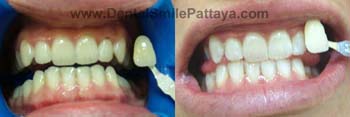
In-office bleaching The LED Cool light Tooth Whitening Procedure.
In just one visit, you can have a stunningly smile with our
LED whitening techniques.
For Those who do not want to bother with
bleaching try at home, we offer our Tooth Whitening by LED cool light. This can be performed entirely in our office. Our dentist start by cleaning each tooth to remove plaque. Then, dentist will protect your gums with a
protective barrier before applies whitening gels onto your teeth. A light will activate the
peroxide gel. The gel stays on the teeth for about 45 minutes to one hour, and then is rinsed off. The patient can still eat drink foods normally.
2. Laser whitening Procedure.
Laser Whitening is one of the most advanced, widely-accepted and
effective tooth whitening methods in current use. It has
transformed the appearance of thousands of patients. Even
for those whose teeth are deeply stained, yellowed or gray
in color, Laser Tooth Whitening offers outstanding results.
It is more than just a cleaning, polishing or whitening of
the tooth surface. Using powerful lasers, we are able to
target stain molecules below the surface, within the
structure of the tooth itself, oxidize them, and remove them
completely.
|
Laser |
Non-Laser |
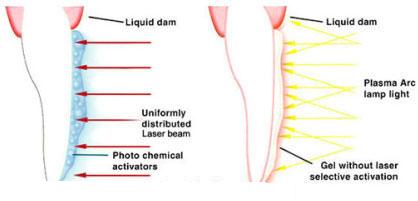
| The laser wavelength
output is synchronized to the proprietary whitening gel,
which increases efficiency and minimizes the amount of
energy required to produce maximum whitening. This results
in shortened treatment time and increases effectiveness
while eliminating the heating of teeth that can result in
post-operative sensitivity. |
Ordinary non-laser
whitening systems require longer treatment times and higher
energy output because of their inefficiencies. Non-laser
whitening devices use just a tiny percentage of the
polychromatic light's energy. The rest of the energy is
wasted as heat and light, which is absorbed by the teeth and
adjacent tissues, which often results in intra-operative and
post-operative sensitivity. |
3. Zoom
tooth whitening Procedure.
Zoom2 is product of Discus Dental Inc, USA who produce BriteSmile system. This is the leading whitening system in USA market. Zoom2! system use light wave ranging of 350-400nm
to activate their patent gel to make your teeth whiter. The company claim approximately 7-8 shades different. This product is designed especially for their own systems.
| |
Treatment time |
Results |
Notes
|
 |
45 Minutes |
Avg. 6-10 shades |
-
Immediate results
- Long lasting
- Less fading
- Safe & Comfortable
- Performed by a dentist |
|
At Home Trays |
7-14 Days |
6 shades |
- Self applied
- By Trays
- No Immediate result |
|
Whitening Strips / Paint on Gel |
7-30 Days |
3 to 4 shades |
- Unstable whitening
- No Immediate results |
|
Tooth Paste |
1
month++ |
1 to 2 shades |
- Tooth become discolor if stop using
- For superfical stains only |
4. At-Home Tooth Whitening
Tooth whitening kits take 2 - 3 weeks to accomplish the desired level of whiteness
and it must be used under prescribtion of a dentist. For Whitening Gel method, your dentist need to check your teeth for cavities because the whitening gel can damage teeth with cavities in them. If
cavities are found, dentist may repair it before performong Tooth Whitening processes. If no cavities are found, the teeth should
be cleaned to remove plaque and take impression for custom
tray, a mouth tray will be custom fitted. Then, dentist will provide a peroxide Tooth Whitening gel. The mouthtray should be filled with the Tooth Whitening gel and wear over night for 2 - 3 weeks.
In Office vs At Home Tooth
Whitening
In Office whitening, dentist will put the bleach gels on your
teeth, then shine a light on the teeth for about 1-2 hours. If you want it done
instantly, you should do it in office.
The actual process takes about 2 hours because there is some
prep time involved. A common one for this process is, Cool light or Laser tooth whitening.
For teeth whitening at home, dentists will take impressions
of your teeth, make Teeth whitening trays for you, and give
you the whitening gel to fill the trays with. You put the
gel into the trays, place the trays in your mouth, go to
sleep (or some people may not want to leave them in that
long) or leave them in for an hour or however long, and you
are done. You will likely need to repeat this process over
multiple days/nights, depending on what type of results you
get.
Rest assured
though, the trays are very comfortable, and are easily
tolerated by most individuals. With this reason, many people
prefer to do the in office teeth whitening to get the
immediate results, then get the trays so they can touch up
at home as they need to down the road.
EXTRINSIC
stains are on the outer layer of the tooth, and many of them
can be bleached out while
INTRINSIC stains are INCORPORATED into the tooth, and it may
or may not be able to bleach these stains out. If they do
come out, it definitely will take much longer and much more
bleaching (months vs weeks). These stains were incorporated
into the tooth structure during tooth development, so they
are not mere surface stains.
Frequently Asked Questions about
Tooth Whitening
|
1.
Does tooth whitening harmful?
|
Teeth whitening
do not harm the teeth, but it can make you sensitive to
extreme hot or cold substances. Teeth whitening agent does
penetrate the enamel which in essence causes the
sensitivity. This sensitivity is usually temporary.
|
|
2. How long will the teeth
remain white? |
|
The long-term effect of the treatment varies
from one person to another. Some behaviors like
smoking, drinking tea and wine, or neglect oforal hygiene can affect the quicken of the teeth discolored
process.
Teeth whitening is not permanent white but it can
fade off over the time. Patient will need to be RE-WHITENED,
or will return to whatever original shade; typically within 1 -
2 years.
|
|
3. Is the treatment
suitable for everyone? |
Basically, teeth Whitening is suitable for
anyone who wishes to lighten his/her tooth color.
Nevertheless, prior to the treatment, a dental examination
will determine whether or not there is any condition that
might prevent the treatment from working as it should. In
such an event the dentist will recommend to undergo the
relevant procedure before beginning the tooth whitening
treatment.
|
|
4. Will the procedure hurt? |
Genernally, this is a very simple procedure there is
no anesthesia required becquse no pain is experienced. However,
several patients may experience minor sensitivity during or
following the procedure. This sensitivity lasts no more than the
first 24 hours and it can be resolved by taking an analgesic.
|
|
5.
What causes teeth discolored?
|
|
There are manyfactors like
tetracycline stains, fluorosis, injury, aging and some dental treatment can cause it too. Depending upon the level of
teeth staining, whitening process can lighten the discolored areas but might not able to
remedy all conditions.
-
TETRACYCLINE is antibiotic often taken for such common maladies as ACNE. It
can stain the teeth if taken during tooth development in yonger children. These stains can be reduced
by whitening, but it may take upto several months or years by home
teeth whitening.
-
FLUOROSIS:
While some fluoride is excellent, too much usage can stain the teeth.
-
TRAUMA:
Teeth that have sustained trauma would eventaully die. In this
case, the teeth become discolor and need to have root canal
treatment done. Fortunately, these teeth can still able to whitening become lighter, but they must be done internally
by the dentist, and after the Root Canal has been finished.
-
DECALCIFICATION:
This has a chalky white appearance, and is actually the
beginning stages of tooth decay. Teeth Whitening your teeth
may make these stains a little less noticeable, but will
probably not remove them completely. They most likely will
need to be filled as cavities if you want them removed
completely.
-
FLUORIDE VARNISHES
can help decrease areas of decalcification as well. The
calcium from your saliva combines with the fluoride to help
reinforce tooth structure.
|
|
|
 |
|